Foundation Installation
Full basement and crawl space foundations for new homes and additions in Germantown.
Learn More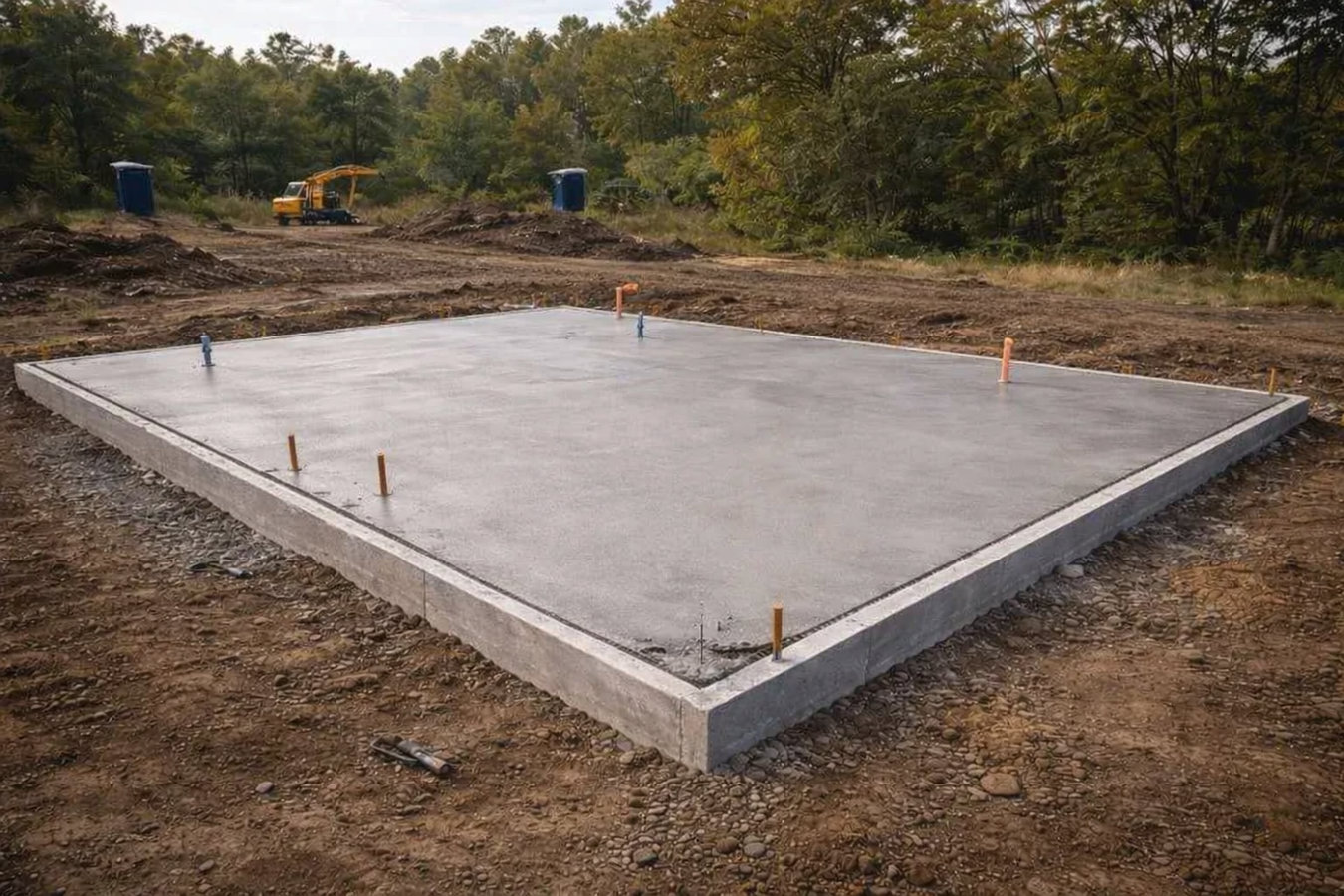
Planning a new build or addition? We pour residential slab foundations that are properly prepped for Germantown's clay soil and Montgomery County permit requirements.
Slab foundation building in Germantown means pouring a reinforced concrete base directly on prepared ground, complete with gravel drainage, a moisture barrier, and steel reinforcement - most residential slabs are completed from site prep through pour in one to two weeks, with a full 28-day curing period after.
If you are starting a new home, garage, or room addition in Germantown, the slab is the first thing that has to be right. Germantown sits on Piedmont clay soil that swells and shrinks with every wet and dry season, so skipping proper soil preparation is the most common reason slabs crack within a few years. Whether your project is a standalone structure or part of a larger build, the prep work under the concrete matters as much as the pour itself.
Many homeowners also need foundation installation for basement or crawl space projects - a slab is one option in a broader foundation decision, and we can walk you through which makes sense for your situation.
If you are starting a new home, garage, or addition, a slab foundation is typically the first step before any framing can begin. Without a properly built slab, nothing else goes up safely. If your architect or contractor has specified a slab in the plans, that is your clearest signal.
Small hairline cracks are normal, but cracks wider than about a quarter inch, diagonal cracks running from corners, or cracks that keep getting longer are worth taking seriously. In Germantown's clay-heavy soil, these often signal that the ground beneath the slab is shifting or settling unevenly.
If water collects against the base of your home's walls after a heavy rain, your slab or surrounding ground may not be draining properly. Standing water near a foundation works its way under the slab over time and can cause serious structural problems - common in Germantown given the area's summer thunderstorm patterns.
When a slab shifts or settles unevenly, the structure above it moves too. Interior doors that suddenly drag, or new gaps between walls and ceilings, can trace back to the foundation. In older Germantown neighborhoods built in the 1970s and 1980s, this kind of settling can develop gradually and is easy to overlook.
Our slab foundation work covers the full scope - from permit application with Montgomery County through final grading after the pour. We handle site excavation, soil compaction, gravel base installation, polyethylene moisture barrier, rebar or wire mesh reinforcement, formwork, the concrete pour, control joint cutting, and curing management. We also coordinate with your plumber to ensure all underground pipes are in place before the concrete goes in, since there is no going back after the slab sets.
For projects that involve more than just a slab, we also offer foundation installation including full basement and crawl space foundations, and concrete footings for decks, additions, and load-bearing structures. Every project starts with an on-site visit so we can assess soil conditions and give you an accurate, itemized estimate.
Suited for new single-family homes, ADUs, and room additions where a flat, reinforced concrete base is the specified foundation type.
Suited for detached garages, workshops, and storage buildings that need a level, durable floor and structural base in one pour.
Suited for existing slabs with wide cracking, settling, or drainage problems that have progressed beyond repair.
Suited for larger footprints or challenging soil conditions where additional tensioning cables or heavier rebar schedules are specified.
Much of Germantown sits on Piedmont Plateau clay soil that behaves differently from the sandy or loamy ground found in other parts of the country. Clay expands when it absorbs water and shrinks when it dries out, and that cycle puts ongoing stress on a slab that was not built to account for it. Proper subgrade compaction, a correctly graded gravel base, and a full-coverage moisture barrier are not optional extras here - they are the baseline for a slab that will stay level for decades. We have seen what happens when those steps get skipped, and it shows up in cracked, heaving slabs a few years after installation.
Montgomery County's permit and inspection requirements also shape how slab projects run in this area. A permit is required before work can begin, and a county inspector checks the work before the project closes out. We handle the permit application and manage the inspection schedule so your project does not stall. Communities like Boyds and Clarksburg to the north see a mix of newer builds and established homes - we have worked in both and know the site conditions that come with each.
Tell us the slab size, what it is for, and whether you have plans ready. We will respond within one business day and schedule a site visit - we never give firm prices over the phone before seeing the soil and grade.
We visit the site, assess soil conditions, and give you a written, itemized estimate covering site prep, materials, labor, and permit fees separately. Once you approve, we file for the Montgomery County building permit - typically a one-to-three week wait.
The crew excavates to the right depth, compacts the subgrade, lays gravel and a moisture barrier, then sets forms and reinforcement. Any underground plumbing is confirmed in place and inspected before we move to the pour.
Concrete trucks arrive and the pour is completed in a single day for most residential slabs. We cut control joints and manage curing for the following week. A county inspector signs off before the permit closes - your project finishes with a clean record.
No obligation. We visit the site, review soil conditions, and give you a written, itemized estimate - so you know exactly what you are paying for before work begins.
(301) 872-6617We compact the subgrade, grade a proper gravel drainage layer, and install a polyethylene moisture barrier on every pour - standard practice in Germantown's Piedmont clay soils. Skipping or rushing those steps is what causes slabs to crack and shift within a few years.
We file the permit application with Montgomery County's Department of Permitting Services and manage the inspection schedule from start to finish. You will know when the inspector is coming and the project will close with a clean permit record - protecting you when you sell or refinance.
We have built slab foundations across Germantown and the surrounding communities, which means we know this area's soil profiles, permit office timelines, and seasonal pour windows. That local track record matters when site conditions drive the outcome.
Every estimate we provide breaks out site preparation, materials, labor, and permit fees as separate line items. You can compare it directly against other bids, and there are no line-item surprises when the invoice arrives. The National Ready Mixed Concrete Association sets quality standards for the concrete mixes we use, and we are happy to discuss mix specs with any homeowner who wants to understand what is going into their slab.
Every slab we pour is backed by our on-site assessment process and a written scope of work. If you are comparing contractors, ask each one specifically how they handle soil preparation in Montgomery County - that answer will tell you more than any credential.
For permit requirements, visit the Montgomery County Department of Permitting Services. For concrete construction standards, the Portland Cement Association publishes free homeowner guidance on slabs and curing.
Full basement and crawl space foundations for new homes and additions in Germantown.
Learn MorePoured concrete footings for decks, additions, and load-bearing structures throughout Montgomery County.
Learn MoreConcrete contractors in Germantown book up fast from April onward - reach out now and lock in your project date.